Arriving at A&A RV Park, which is near the entry road to Mesa Verde is a visual experience in itself. The campsites are comfortable, level and have dependable water and electric. The site we were in had a wonderful view of a rugged but very neat monolith.
The scenic views of the San Juan mountains are a fitting start to a day in Mesa Verde. Names like Montezuma valley and Sleeping UTE Mountain set the scene for the day that follows.


Surrounding the park on three sides is the Ute Mountain Indian Reservation and this day we would be caught up in a Ute legend. A disgruntled God gathers up all of the clouds and then puts them in his pocket and then lays down to sleep. If you look closely, you can make out the sleeping god on top of Sleeping Ute Mountain. The Utes believe that when the clouds are hanging in storm formations that they are escaping from the God's pocket.We were able to see a large number of angry clouds escaping from the God's pockets this day. Fortunately the bad part didn't come until we were finished touring Mesa Verde. I wonder if this means the God's were smiling on us?


Mesa Verde's geologic features are primarily sandstone which is a porous, relatively easy stone to break. Rain and melting snow seep through the sandstone and eventually come to the surface as a spring. The Anasazi people built their buildings and farm fields near these springs. These springs furnished water for the populace and good growing conditions for wild and cultivated plants.


Interesting plants which were used for food, medicine or ceremonial rite are abundant in the areas near the springs. This is prime Pinion Pine territory and the pine nuts were a staple in the Anasazi diet.


The other dominant tree species is the juniper. The berries from the Juniper were used as seasoning in food and for medicinal purposes. The bark of the Juniper was used to diaper babies.

Yuccas were used to make baskets, sandals, mats and clothing. The cucumber looking fruit of the Yucca is starchy sweet with a flavor similar to bananas and was used dried or eaten as a fruit or to flavor meals.
The Utah Serviceberry has berries which were eaten raw or preserved for future use as a flavoring.The Gambel Oak provided acorns which were dried or roasted before being eaten.


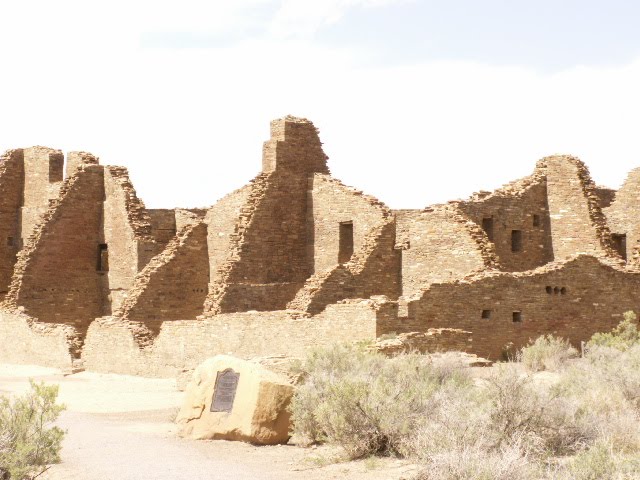
The Spruce Tree House Pueblo was built between 1200 and 1276 and had 114 rooms and 8 kivas. A kiva is a round ceremonial room used for religious purposes and common rooms.
This settlement was built in a natural cave, and the evidence of many fires is evident on the cave ceiling.


The typical room was 6 X 8 X5.5 feet and housed one or two people. The rooms were primarily used as bedrooms. There is evidence that fires were burned in some rooms, but they had to be very smokey since there was no ventilation to exhaust the smoke.


Much of the work, in fair weather, was done in the courtyard. However, in poor weather the work moved inside.
The Kivas had the only efficient fireplace. There was a ventilation shaft which allowed air to come down into the Kiva where it was deflected to the sides by a large slab of rock. This air then combined with the smoke and exhausted through the hole on the ceiling which served as an entrance way. My guess is that once you were in the Kiva and the fire was lit, you stayed in the Kiva or were cooked on the way out.

The Anasazi people's creation myth was that man came from the underworld to the surface of the Earth. For that reason the Kivas had a small hole, called a Sipapu, in the floor. There was also small holes in the walls for ceremonial items or offerings.


Somewhere in the mid 700s the nomadic Anasazi People started to settle in one area. No-one understands why the nomad would settle down. Perhaps it was because they had been introduced to farming and food storage by other Indians. How's that for a guess? The early settlement were in pit houses which were roofed with wood and thatch.
The reason I put the building of the pit houses out of historical sequence is because it was interesting they used the same ventilation system that would only be used in the Kivas during latter construction.
The pit house changes, over many years,went from simple dug outs covered with a roof of natural
materials, to a more complex dug out lined with stone and covered with the same materials.

Early pit house